
Originally developed for use in surgical sutures, PDO threads have found a significant role in the field of cosmetic dermatology due to their safety, biocompatibility, and ability to stimulate collagen production.
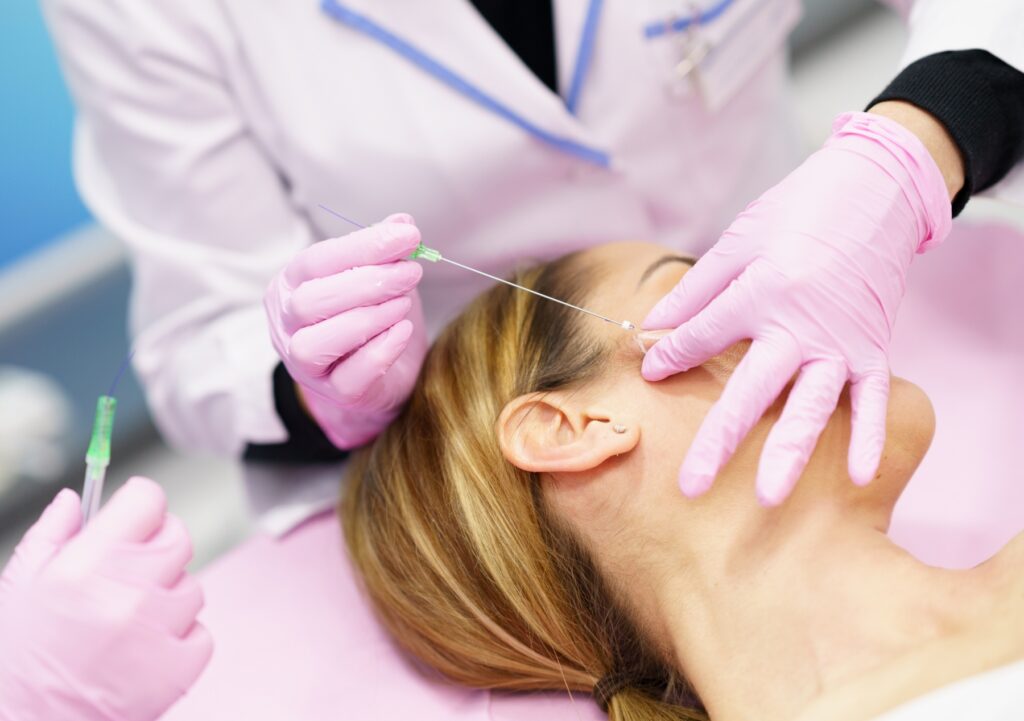
These threads are gently inserted into the skin using fine needles or cannulas and come in different types—mono, cog, and screw threads—each serving a specific purpose, from skin tightening to lifting sagging areas. Over time, the PDO threads dissolve naturally in the body, but their effects can last for months, leaving behind firmer, smoother, and more youthful-looking skin.
Benefits of PDO Threads
- Collagen Stimulation: PDO threads induce the body’s natural healing response, stimulating collagen production. This process enhances skin elasticity and firmness over time.
- Improved Skin Texture: The increased collagen not only tightens the skin but also improves its texture, reducing the appearance of fine lines and wrinkles.
- Minimally Invasive: Unlike traditional facelifts, PDO thread lifts are less invasive, requiring only local anesthesia and resulting in minimal scarring.
- Immediate Results: Patients often notice an immediate lifting effect, with continued improvements as collagen production increases.
- Safe and Biodegradable: PDO threads are made from a biocompatible material that safely dissolves in the body over time.
What Makes PDO Threads Different?
PDO threads stand out due to their dual action: mechanical lifting and biological rejuvenation. The threads provide immediate support to sagging skin, while their presence stimulates collagen production, enhancing skin quality over time. Their biodegradability ensures they are safely absorbed by the body, eliminating the need for removal.
Types of PDO Threads
- Mono Threads: Smooth threads inserted into the skin to stimulate collagen production, leading to skin tightening and rejuvenation. Ideal for treating fine lines and improving skin texture, making it a popular choice for people younger than 30 who haven’t experienced dramatic sagging yet. Mono threads do not have barbs like the cog and screw. They go into the skin like how mesh would. This insertion gives the skin a tightening effect and it is easy for the technician to insert 5-20 mono threads in one session.
- Cog Threads: Cog threads are the thickest of all three types and feature barbed threads. While the word “barbed” may sound intimidating, the procedure is no more painful than with the other thread types. The barbs help create structure for sagging skin and eliminate the need for anchor points, unlike mono threads. Cog threads are commonly used in areas such as the cheeks, brows, and jawline—regions of the face that typically require lifting. They not only lift sagging tissues but also stimulate collagen production for improved skin texture and firmness.
- Screw Threads: Twisted threads that offer volume restoration in sunken areas of the skin.
Potential Complications and Side Effects
While PDO threads are generally safe, potential side effects include:
- Swelling and Bruising: Common and typically subside within a few days.
- Infection: Rare but possible; maintaining proper hygiene and following aftercare instructions can mitigate this risk.
- Thread Migration or Extrusion: In rare cases, threads may move or become visible under the skin.
- Asymmetry or Dimpling: Uneven results may occur if threads are not placed correctly.
Ideal Candidates
PDO threads are best suited for individuals:
- Aged between 30 and 55 years.
- Experiencing mild to moderate skin laxity.
- Seeking non-surgical facial rejuvenation.
- Without significant medical conditions that impair healing.
Long-Term Maintenance and Restrictions
The effects of a PDO threads can last between 12 to 24 months, depending on individual factors and lifestyle. To maintain results:
- Follow a healthy skincare regimen.
- Avoid excessive sun exposure.
- Refrain from smoking and excessive alcohol consumption.
- Consider periodic touch-up treatments as recommended by your practitioner. Recovery
Recovery from a PDO thread is relatively quick:
- Most patients resume normal activities within a few days.
- Minor swelling or bruising may occur but typically resolves within a week.
- Strenuous activities should be avoided for at least one week post-procedure. Aftercare
Proper aftercare ensures optimal results:
- Avoid touching or applying pressure to the treated area for 48 hours.
- Sleep on your back with your head elevated for the first few nights.
- Refrain from facial massages or aesthetic treatments for at least two weeks.
- Avoid excessive facial movements, such as yawning or chewing hard foods, for a few days.
Conclusion
PDO threads offer a safe and minimally invasive way to improve skin firmness and texture. By stimulating collagen production, they help achieve a natural, refreshed appearance with minimal downtime. With growing popularity, they are a trusted option for those seeking subtle facial rejuvenation.
FREQUENTLY ASKED QUESTIONS
Q. What are PDO threads in aesthetics?
PDO (Polydioxanone) threads are absorbable sutures used in non-surgical cosmetic procedures to lift, tighten, and rejuvenate the skin by stimulating collagen production. Q. How long do PDO threads last in the skin?
PDO threads dissolve naturally in the body over 6–9 months, but the collagen-stimulating effects can last up to 12–18 months depending on skin condition and thread type. Q. Is the material safe?
Yes. PDO is a biocompatible, medical-grade material used for decades in surgical suturing with a high safety profile and minimal risk of allergic reaction.
Q.What is the ideal age range for PDO threads to work effectively?
PDO thread lifts tend to yield the best results for people in their late 30s to early 50s. This is the age group where early signs of sagging and reduced skin elasticity start to become noticeable but are still mild to moderate.
Q. What are the different types of PDO threads?
There are three main types, each designed for a specific purpose:
- Mono Threads:
Smooth, single-strand threads used to improve skin texture and elasticity. They do not lift, but they stimulate collagen and are ideal for fine lines and general skin rejuvenation.
- Cog Threads:
Barbed threads that physically lift sagging skin by anchoring into tissue. Commonly used for jawline, cheeks, and jowls. Also stimulate collagen.
- Screw Threads:
Twisted threads (single or double) that add volume and are often used for hollow or sunken areas, such as under the eyes or nasolabial folds. Q. Do Mono Threads provide a lifting effect?
Mono Threads are not designed for lifting. Unlike PDO Cog Threads, which have barbs to anchor tissue, Mono Threads are smooth and meant to be absorbed by the body over time. While some subtle skin tightening may occur, the primary purpose is collagen stimulation rather than lifting.
Q. Which thread is more suitable- MONO or COG?
The suitability of Mono or Cog threads depends on the patient’s skin condition and desired outcome. Here’s a breakdown to help differentiate between the two:
| Feature | Mono Threads | Cog Threads |
| Structure | Smooth, single strand with no barbs | Barbed threads that hook into tissue |
| Primary Function | Stimulates collagen to improve skin texture | Lifts and repositions sagging skin while stimulating collagen |
| Lifting Effect | No lifting effect | Provides lifting |
| Best For | Fine lines, texture, early aging signs | Sagging cheeks, jawline, jowls, and contour reshaping |
| Ideal Age Group | 25–40 years | 35+ years |
| Placement Areas | Forehead, under-eye, neck, nasolabial area | Midface, jawline, lower face, and neck |
| Combination Use | Often used in mesh pattern or with screw threads for volume | Often combined with Mono threads for full-face rejuvenation |
- Choose Mono Threads if the goal is general skin tightening, firmness, and collagen stimulation without changing facial structure.
- Choose Cog Threads if the goal is to lift sagging skin, redefine contours, or achieve a more sculpted facial appearance.
Q. Why do the results take several weeks to appear?
Collagen production is a slow, natural process. As we age, collagen levels drop, contributing to wrinkles and sagging. Mono Threads stimulate new collagen growth, which typically begins to show around 8 weeks post-treatment and continues to improve over 12 weeks. This newly formed collagen can support skin quality for 2–3 years. Q. Are there risks or side effects?
Mild discomfort, bruising, or swelling may occur. Rare risks include thread migration or puckering—usually avoidable with proper technique.
References
1.Polydioxanone (PDO) Threads: A Comprehensive Guide.
(2025). Internal report, ZEVANEX PHARMACEUTICAL5 PDO THREAD Guide
3.Sulamanidze, M. A., Fournier, P. F., Paikidze, T. G., & Sulamanidze, G. M. (2002). Removal of facial soft tissue ptosis with special threads. Dermatologic Surgery, 28(5), 367–371.
4.de Almeida, A. T., Radaelli, G., Pavani, C., & Zaninelli, E. M. (2017). Polydioxanone thread lifting for facial rejuvenation: Clinical experience and outcomes. Journal of Cosmetic Dermatology, 16(4), 421–426.
5.Lycka, B., Bazan, C., Poletti, E., & Trelles, M. A. (2004). The emerging technique of thread lifting for facial rejuvenation: A review of the literature. Journal of Cosmetic and Laser Therapy, 6(4), 171–177.
6.Wu, W. T. (2019). Barbed suture thread lifting: Indications, techniques, and outcomes. Aesthetic Plastic Surgery, 43(2), 405–415.
7.Shin, J. Y., & Kim, Y. J. (2018). Long-term effects of PDO cog thread lifting in the midface. Aesthetic Surgery Journal, 38(6), 654–662.
8.Villa, D., & Trelles, M. A. (2020). Minimally invasive facial rejuvenation with absorbable PDO threads: Current perspectives. Clinical, Cosmetic and Investigational Dermatology, 13, 885–893.